Are you looking for somewhere with an engineering theme to visit? Why not try our
Places of Interest map on the Useful Info menu?
Our Mission
Welcome to the Norwich Engineering Society, an active forum dedicated to fostering the exchange of ideas and experiences among all those passionate about engineering — past, present, and future.
For over a century, we have focused on the people behind groundbreaking innovations and their visionary concepts. Our mission is to enlighten, support, and develop our members in Norfolk and beyond. We achieve this through unique engagements, dynamic events, informative seminars, and insightful publications.
By championing the diverse disciplines within engineering, we ensure its continued evolution and relevance in an ever-changing world.
Development of a medical Device:CAVA
Mon 5th October 2026
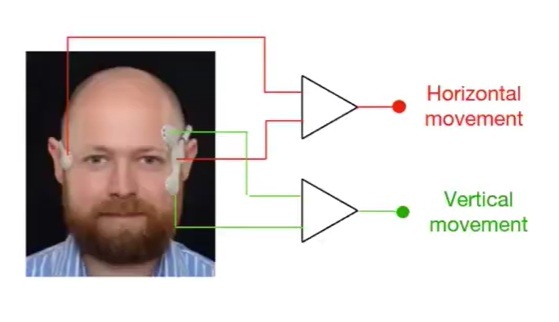
The CAVA sensors attached to Dr John Phillips with a schematic of the associated Signal Conditioning
To a well attended Meeting both in person and online, Prof Stephen Cox of UEA, opened our 2026-2027 Season with a description of some work he and his team had done in the development of a device to assist in the diagnosis of the possible underlying conditions causing dizziness in prenting patients at the ENT(Ear, Nose and Throat) Department at the NNUH under the auspices of Dr John Phillips, a Consultant there.
As Stephen pointed out, dizziness is a significant problem for the NHS with its aging population particularly as it has several major causes; low blood pressure, drug side effects and inner ear disorders (vestibular). Because the work described by Stephen originated in ENT, the project together with any associated devices was given the acronym CAVA; Continuous Ambulatory Vestibular Assessment. One of the major indicators associated with inner ear disorders is the condition known as Nystagmus where the patient presents oscillatory (of order 1Hz) eye movements either horizontally, vertical or circular. Unfortunately, for diagnostic purposes, these movements occurs in bursts of a few cycles and happen infrequently so are rarely seen in a clinical session. What is needed is a device that records a time history of such events over several days.
Fortunately it is known that when these movements occur small potential differences are developed around the eye and can be detected on the skin surfaces close to the ocular region. Stephen briefly described the sensors used to detect these potentials and the signal conditioning needed to get them up to the levels needed to record them in reproducible formats. He then spent a little time describing the process of recording the data and how the practical systems were produced. The main part of his talk, however, was spent on how the resulting data was analysed and interpreted.
As Stephen described, this was not as straightforward as it might be thought. The bursts are infrequent, vary in nature and can also be of different frequencies. A lot of effort had to be put into designing algorithms for this search process.
As Stephen concluded with some feeling, all this hard work was not helped by the time and effort that had to be put into seeking financial support and the catastrophic effect of Covid halting any patient interaction in the period 2020-2023.
AGM+short talks
Mon 30th March 2026
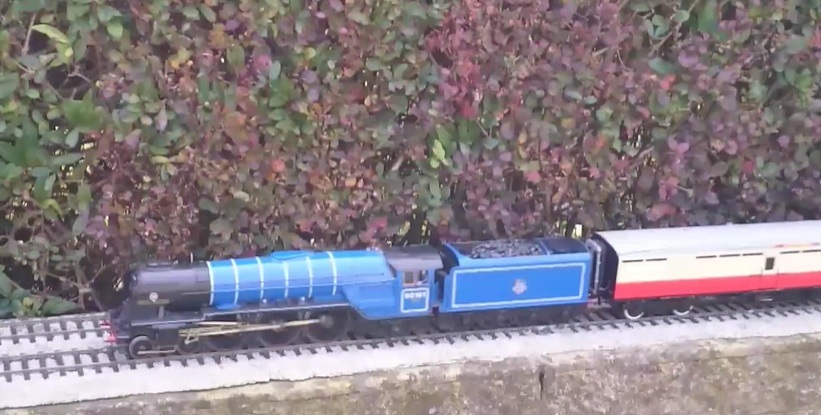
Hand built model LNER A1 locomotive by Paul Hindmarsh
The President, Dorian Hindmarsh, opened the AGM with a welcome to all the attendees, both those present and those who had joined online. He then went on to give a brief outline of what the Society had been up to in the last year and how enjoyable year it had been despite the last minute changes to the programme. He thanked in particular those Members who had rallied round and filled the gaps. He concluded his thoughts with thanks to both the Secretary and the Treasurer for all their efforts on the administrative running of the Society.; in particular, getting the Membership lists clarified after the troubles caused by the covid pandemic.
After the President concluded his report, both the Secretary and the Treasurer gave their annual reports. Both were well received by Members present both in person and virtually. One of the major matters reported by the Treasurer was that the finances of the Society were in sound health. In particular, the Treasurer proposed that subscriptions should be the same for 2026-2027 as in 2025-2027. This was agreed by all present. After the Council Officers reports the meeting proceeded to elections. The President reported that there had been no proposals submitted for alternative Members of Council but that a current Member of Council, Tony Meacock, had decided that time had caught up with him and that he would not be putting his name forward for Council in the upcoming season. The President thanked Tony for all the positive contributions he had made to the good running of the Society. The President then proposed that the remaining Council Members and Officers served for the next season. This unanimously accepted by all Members present.
The second part of the AGM was taken up with two presentations by Members. The first was by the Presented and the second by former President Tony Meacock. The talk by Dorian was a memorial to his father, Paul, who spent most of his working life as a freelance photographer with a speciality of the industrial scenes in the Newcastle upon Tyne area. However, his relaxation was in model railway engineering; the part of his life that Dorian concentrated on. He told is that his father was meticulous and everything was constructed to an extremely high standard. Dorian brought several examples of the work by Paul for the audience to admire
The presentation by Tony was not so much a talk as a series of amusing video clips with a somewhat tenuous at times link to engineering.
GWR Battery powered Branch Line train tests
Mon 23rd March 2026
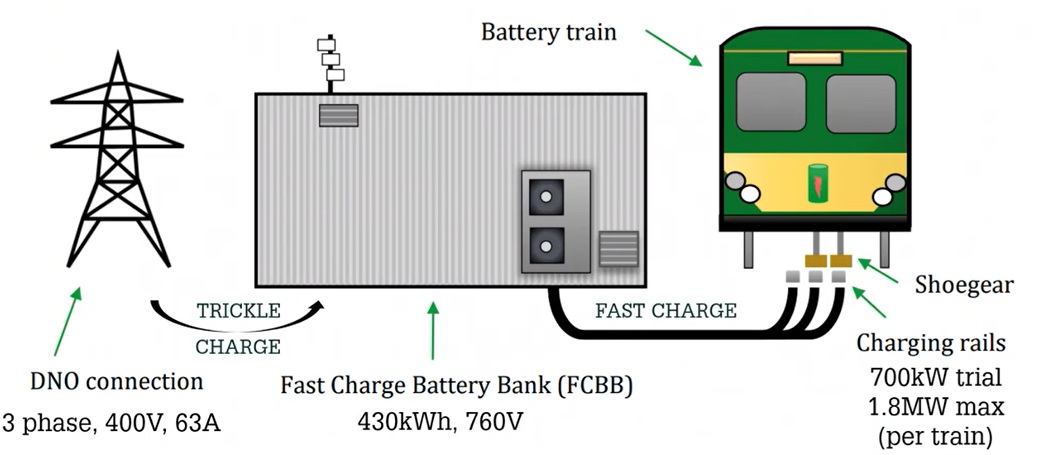
Fast charging system schematic
The President opened this session with an apology that the intended speaker had had to withdraw because of a family funeral. He thanked Richard for being able to offer a talk at relatively short notice.
Richard started his talk by stating that the UK Government had decided that the UK railway system had to be free of all hydro-carbon powered units by 2040. The implication is that all power units have to be electrically powered by that date either by ground based power rails or overhead wires or driven from fuel cells or electrochemical batteries. Some time ago the rail industry had turned its face against ground based power rails and fuel cells are mostly hydrogen based and as cheap hydrogen is produced by hydro-carbon processes this too has been sidelined by the railway system.
Where a significant portion of a network has been electrified the 2040 date is not a problem but for some companies it becomes a significant problem if a large fraction of their system is powered by an aging fleet of diesel units. The Great Western (GWR) is one such company. Richard indicated that his talk was essentially a report on one of the projects that the GWR was trying out to solve this problem.
Richard told his audience that this particular project started significantly before the UK Government decision with the foundation of Vivarail that acquired a significant number of redundant District Line power units with a view to refurbishing them to run as diesel electric hybrid or pure battery. The refurbishing was intended to use state of the art electric motors, up to date battery technology and modern computer based control systems. Sadly, because of the financial/political conditions of the early 2020s and despite significant progress and success in many areas Vivarail was forced into administration. GWR, with help from Innovation UK, acquired the IPR and the team of associated engineers from the admistrators with the view to following up the success that Vivarail had had with its battery powered units. In particular, GWR was interested in the fast charging approach of Vivarail.
Richard then used the rest of the talk to describe the design and the proving tests being undertaken to validate this novel system.
HM Coastguard: to search, to rescue, to save
Mon 9th March 2026
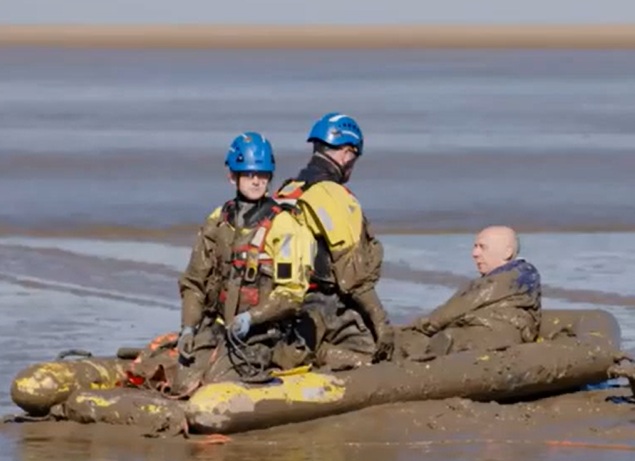
A typical mud rescue event
Richard started his talk by explaining that HM Coastguard (HMCG) are one of the four statutory emergency organisations in the UK; their the role being that of any emergencies occurring on the sea or sea-land interfaces including river estuaries. He also suggested that few of his audience knew what the HMCG got up to. He also dispelled the idea that all sea emergencies were dealt with by the RNLI; it is the HMCG who are the operational Authority.
Formally HMCG are 200 years old but the history goes back at ;east until Norman times when William 1 appointed his half brother Bishop Odo as admiral of his coastguard. Since the days of Odo, HMCG have evolved to their current role. To be an operational member of the Coastguard you have to have a level of fitness similar to that of the active branches of the armed services. HMCG are are organised around operational stations dispersed around the UK coast with the stations being grouped into regional sectors. If a given sector is reaching close to saturation in calls upon its resources its role is taken over by the nearest sector with available resource. Richard also informed us that each station tends to be specialised in certain rescue methods. For instance the stations in southern England tend to be skilled in mud rescues because the majority of their search and rescues are estuarine in nature.
Richard devoted the last part of his talk to an interactive discussion with his audience of several real life events within his coast guarding experience. For example he looked at a recent event where somebody had bought a boat unseen and had decided to come and test his purchase out without informing anyone that this was his plan. Sadly the boat failed to live up to expectations with the electrics malfunctioning and he had become marooned on a mud flat. Eventually his situation was reported in by a member of the public and the coast guard alerted. Richard then took us through the various processes and procedures that had to be gone through to affect a successful search and rescue.